биография ван гога на английском
Биография Винсента Ван Гога на английском языке
Здесь вы можете прочитать биографию Винсента Ван Гога на английском языке.
Vincent van Gogh was a Dutch post-impressionist painter. His paintings are now highly valued in the world of art. He was born in the Southern Netherlands on March 30, 1853. His father was a pastor. Vincent wasn’t the only child in the family; he had two brothers and three sisters. In 1869 not even finishing the secondary school he left for Hague to work there at one large art company. In painter’s family all men somehow dealt either with religion or with art.
By the age of twenty Vincent decided to change his work area and to follow his father’s steps. He soon found pastor’s assisting job in the suburbs of London and moved there. His first sermon was held on October 29, 1876. A year later he moved back to the Netherlands to study theology at the University of Amsterdam. Time spent in London had considerably changed the artist’s life and views. Firstly, he had a good salary, so he could afford to visit various art galleries and museums. Secondly, he became a successful trader and could have an excellent career.
However, everything changed when he fell in love with his flat owner’s daughter, who had already been engaged. Facing this fact, he became indifferent to his work and to other joyful things in life. He lost his job and returned to the Netherlands. The only solace he found was religion. Having moved to Amsterdam, he began studying priesthood, but soon dropped the faculty. When he was about thirty-three Vincent moved to Paris to stay with his brother Theo.
There he got a chance to take painting lessons from F. Cormon and to meet such artists as Gauguin, Pissarro and others. He soon forgot all the misfortunes and became a recognizable and respectful artist. He largely developed the styles of impressionism and post-impressionism. At the same time he still worked as a preacher in one evangelical church. By the age of twenty-seven he knew exactly that he would dedicate his life to art. Although he took some drawing lessons, he was considered a self-taught painter, as he read lots of tutorials and had his own style.
Unfortunately, the painter’s life was soon again filled with love sufferings. This time it was his widowed cousin Kee Vos. She was also the reason why he quarreled with his father and moved to Hague. He met a woman of easy virtue there. Wishing to save her from her numerous sins, Vincent was even willing to marry her, but again his family interfered and thoughts of marriage were simply shattered. Returning to his home place he improved his drawing skills.
Soon he returned to Paris to his brother Theo, who always helped and supported him in every possible way. In fact, France for van Gogh was almost like the motherland. He spent all the rest of his life there, feeling like home. He was a person with difficult and explosive character. Some people even called him a crazy lunatic. Nevertheless he had his own friends who kept him a company. In 1888 he moved to Arles where he planned to create a settlement for artists. When he shared his idea with his friend Gauguin, they became enemies.
In the burst of anger van Gogh cut off his own left ear. After this case he was placed for two weeks in psychiatric hospital. Even after returning home he suffered from occasional hallucinations and had to re-start the treatment. In 1890 he finally left the hospital and went to Theo’s home, whose wife had just given birth to the son they named Vincent after his uncle. This peaceful happiness didn’t last. In July1890 van Gogh shot himself. The painter died in his brother’s arms, who loved him very much. Six months later his brother Theo also died and was buried next to Vincent.
Винсент Ван Гог
Today Vincent Van Gogh is supposed to be one of the greatest Dutch painters. He was not famous, popular and rich while alive. Moreover, mr. Van Gogh remained poor and virtually unknown from the cradle to the grave.
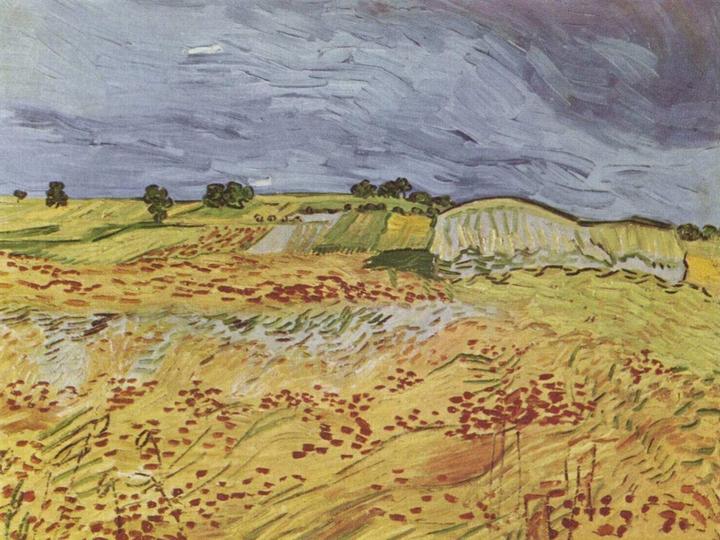
The great artist was born in 1853, Netherlands. His style is applicable to post-impressionists’ movement and all his works are characterized by unique beauty, emotion and color. When he was a child painting was a hobby, but became a profession in the adulthood. All his works were full of sun and good mood and nowadays people don’t understand why his paintings were not sold. Perhaps, it was caused by the specific feature of the artist’s style.
He created the unusual mixture of impressionism and expressionism. It had rarely been done before, if two arts were combined. The most popular works of the artists are following: ‘Starry Night’, ‘Sunflowers’, ‘Bedroom in Arles’, ‘Portrait of Dr Gachet’ and ‘Sorrow’. Most of them are regularly copied by beginning artists to learn how to draw. In certain circles Van Gogh is known as a crazy man, who, according to legend, bit his ear off. Van Gogh died in France on July 29, 1890, at age 37, from a self-inflicted gunshot wound.
На сегодняшний день Ван Гог считается одним из величайших голландских живописцев. Он не был известным, популярным и богатым при жизни. Кроме того, мистер. Ван Гог оставался бедным и практически неизвестным на протяжении всей своей жизни.
Великий художник родился в 1853 году, в Нидерландах. Его стиль относится к пост-импрессионистскому течению, и все его произведения отличаются неповторимой красотой, эмоциями и цветом. Когда он был ребенком, живопись была его хобби, а во взрослой жизни стала профессией. Все его произведения были полны солнца и хорошего настроения, и сегодня люди не понимают, почему его картины не продавались. Возможно, это было вызвано особенностью стиля художника.
Van Gogh — топик по английскому
Рубрика: Биографии

Vincent Van Gogh was one of the greatest painters of the XIX century. Van Gogh was born in 1853 in Holland; however, he spent most of his life in France.
Van Gogh’s life could hardly be considered the happy one. He was mentally ill and was aggressive from time to time. During one of his fits of nerves he cut a part of his ear off. Although Van Gogh went into a mental hospital several times, his state didn’t become any better. Furthermore, the great artist lived a rather short life. In 1890 he shot himself after pronouncing his last words: “The sadness will continue”.
It is difficult to believe that the one who painted such bright puctures was so desperate and unhappy at the same time. All his masterpieces depicted beautiful fields, splendid flowers, and sunny regions of France in vibrant colours and interesting shapes. His painting was far from classical art but was still fascinating.
Van Gogh preferred working fast that’s why a specific movement is seen in his works. Even the moon and stars move in his magnificent pictures.
Today it is possible to see Van Gogh’s masterpieces in many galleries and museums all over the world. However, the most famous museum dedicated to his art is situated in Amsterdam. The exhibition tells about the life of the great painter and introduces the World’s biggest collection of his works.
Перевод:
Винсент Ван Гог был одним из величайших художников 19 века. Ван Гог родился в 1853 году в Голландии. Однако большую часть жизни он провел во Франции.
Жизнь Ван Гога едва ли можно назвать счастливой. Он был душевно больным и время от времени проявлял агрессию. Во время одного из своих нервных припадков он отрезал себе часть уха. Хотя Ван Гог несколько раз лечился в психиатрической больнице, это не улучшило его состояния. Более того, выдающийся художник прожил весьма непродолжительную жизнь. В 1890 году он застрелился, произнеся свои последние слова: «Печаль продолжится».
Сложно поверить, что человек, написавший такие яркие картины, был в то же время настолько отчаявшимся и несчастным. Все его шедевры изображают красивые поля, восхитительные цветы, солнечные регионы Франции в сочных цветах и интересных формах. Его живопись была далека от классической, но все же завораживала.
Ван Гог предпочитал работать быстро, поэтому в его работах заметно особое движение. Даже луна и звезды двигаются на его поразительных картинах.
Сегодня шедевры Ван Гога можно увидеть во многих галереях и музеях мира. Однако наиболее известный музей, посвященный его искусству, находится в Амстердаме. Выставка рассказывает о жизни великого художника и представляет крупнейшую в мире коллекцию его работ.
Слова и фразы по теме:
Vincent van Gogh

Biography of Vincent van Gogh

Van Gogh received a fragmentary education: one year at the village school in Zundert, two years at a boarding school in Zevenbergen, and eighteen months at a high school in Tilburg. At sixteen he began working at the Hague gallery of the French art dealers Goupil et Cie., in which his uncle Vincent was a partner. His brother Theo, who was born 1 May 1857, later worked for the same firm. In 1873 Goupil’s transferred Vincent to London, and two years later they moved him to Paris, where he lost all ambition to become an art dealer. Instead, he immersed himself in religion, threw out his modern, worldly book, and became «daffy with piety», in the words of his sister Elisabeth. He took little interest in his work, and was dismissed from his job at the beginning of 1876.
Van Gogh then took a post as an assistant teacher in England, but, disappointed by the lack of prospects, returned to Holland at the end of the year. He now decided to follow in his father’s footsteps and become a clergyman. Although disturbed by his fanaticism and odd behavior, his parents agreed to pay for the private lessons he would need to gain admission to the university. This proved to be another false start. Van Gogh abandoned the lessons, and after brief training as an evangelist went to the Borinage coal-mining region in the south of Belgium. His ministry among the miners led him to identify deeply with the workers and their families. In 1897, however, his appointment was not renewed, and his parents despaired, regarding him as a social misfit. In an unguarded moment, his father even spoke of committing him to a mental asylum.
His parents could not go along with this latest change of course, and financial responsibility for Vincent passed to his brother Theo, who was now working in the Paris gallery of Boussod, Valadon et Cie., the successor to Goupil’s. It was because of Theo’s loyal support that Van Gogh later came to regard his oeuvre as the fruits of his brother’s efforts on his behalf. A lengthy correspondence between the two brothers (which began in August 1872) would continue until the last days of Vincent’s life.
When Van Gogh decided to become an artist, no one, not even himself, suspected that he had extraordinary gifts. His evolution from an inept but impassioned novice into a truly original master was remarkably rapid. He eventually proved to have an exceptional feel for bold, harmonious color effects, and an infallible instinct for choosing simple but memorable compositions.
In order to prepare for his new career, Van Gogh went to Brussels to study at the academy, but left after only nine months. There he got to know Anthon van Rappard, who was to be his most important artist friend during his Dutch period.
In April 1881, Van Gogh went to live with his parents in Etten in North Brabant, where he set himself the task of learning how to draw. He experimented endlessly with all sorts of drawing materials, and concentrated on mastering technical aspects of his craft like perspective, anatomy, and physiognomy. Most of his subjects were taken from peasant life.
At the end of 1881 he moved to The Hague, and there, too, he concentrated mainly on drawing. At first he took lessons from Anton Mauve, his cousin by marriage, but the two soon fell out, partly because Mauve was scandalized by Vincent’s relationship with Sien Hoornik, a pregnant prostitute who already had an illegitimate child. Van Gogh made a few paintings while in The Hague, but drawing was his main passion. In order to achieve his ambition of becoming a figure painter, he drew from the live model whenever he could.
In September 1883 he decided to break off the relationship with Sien and follow in the footsteps of artists like Van Rappard and Mauve by trying his luck in the picturesque eastern province of Drenthe, which was fairly inaccessible in those days. After three months, however, a lack of both drawing materials and models forced him to leave. He decided once again to move in with his parents, who were now living in the North Brabant village of Nuenen, near Eindhoven.
At the end of 1884 he began painting and drawing a major series of heads and work-roughened peasant hands in preparation for a large and complex figure piece that he was planning. In April 1885 this period of study came to fruition in the masterpiece of his Dutch period, The Potato Eaters
In the summer of that year, he made a large number of drawings of the peasants working in the fields. The supply of models dried up, however, when the local priest forbade his parishioners to pose for the vicar’s son. He turned to painting landscape instead, inspired in part by a visit to recently opened Rijksmuseum in Amsterdam.
In 1885, feeling the need for a proper artistic training, Van Gogh enrolled at the academy in Antwerp. He found the lessons rather tedious, but was greatly impressed by the city and its museums. He fell under the spell of Peter Paul Rubens’ palette and brushwork, and also discovered Japanese prints.
In early 1886 Van Gogh went to live with his brother in Paris. There, at last, he was confronted with the full impact of modern art and especially with the recent work of the Impressionists Claude Monet, Paul Cezanne, Edouard Manet and postimpressionists Paul Gauguin. He discovered that the dark palette he had developed back in Holland was hopelessly out-of-date. In order to brighten it up, he began painting still lifes of flowers. The search for his own idiom led him to experiment with impressionist and postimpressionist techniques and to study the prints of Japanese masters. During his time in Paris he made friends with such artists as Paul Gauguin, Emile Bernard, Paul Signac, and Georges Seurat. Within two years Van Gogh had come to terms with the latest development and had forged his own, highly personal style.
At the beginning of 1888, Van Gogh, now a mature artist, went south to Arles, in Provence, where he at last began to feel confident about his choice of career. He set out to make a personal contribution to modern art with his daring color combinations. He was swept away by the landscape around Arles. In the spring he painted numerous scenes of fruit trees in blossom, and in the summer the yellow wheat fields. Although he had some difficulty finding models, he did make portraits, among which were those of the Roulin family. It was typical of Van Gogh’s faith in his own abilities that he decided not to try to sell any work yet but to wait until he had thirty top-class pictures with which he could announce himself to the world. He cherished the hope that a number of other artists would come and join him in Arles, where they could all live and work together. The idea seemed to get off to a promising start when Gauguin arrived in October 1888.
Toward the end of the year, however, his optimism was rudely shattered by the first signs of his illness, a type of epilepsy that took the form of delusions and psychotic attacks. It was during one of those seizures that he cut off his left earlobe. Gauguin made a hasty departure and Van Gogh’s dreams of an artist’s colony disappeared.
In April 889 he went to nearby Saint-Remy, where he entered the Saint-Paul-de-Mausole asylum as a voluntary patient. Van Gogh was unable to work where when suffering from bouts of his illness. If he felt well enough, though, he went out to draw and paint in the garden or surroundings of the asylum. His use of color, which had often been so intense in Arles, became more muted, and he tried to make his brushwork more graphic. In the closing months of the year, he had a success when two of his paintings were shown at the fifth exhibition of Societe des artistes independents.
Van Gogh also made a large number of «translations in color» of prints by some of his favorite artists, like Millet and Eugene Delacroix. He found them consoling, and they helped him keep in practice.
In January 1890 the critic Albert Aurier published an enthusiastic article about Van Gogh’s work.
The artist left Saint-Remy in May 1890 and went north again, this time to the rustic village of Auvers-sur-Oise, near Paris. On his way, he stopped off in Paris to call on Theo, his wife Johanna, and their infant son Vincent Willem.
Although he now had a small but growing circle of admirers, Van Gogh had lost his original passion. He wrote to his brother:
He nevertheless continued working hard during his two months in Auvers, producing dozens of paintings and drawings. On 27 July 1890, Vincent van Gogh was shot in the stomach, and passed away in the early morning of 29 July 1890 in his room at the Auberge Ravoux in the village of Auvers-sur-Oise. Although official history maintains that Van Gogh committed suicide, the latest research reveals that Van Gogh’s death might be caused by an accident.
 |
| Vincent van Gogh and his brother Theo van Gogh’s Tomb |
Today, Van Gogh is generally considered the greatest Dutch painter after Rembrandt.
My English Pages | Learn English Grammar Online
Short biography of Van Gogh
Develop your reading skills.
Vincent Van Gogh (30 March 1853 – 29 July 1890)

Vincent Willem van Gogh is a well-known Dutch post-Impressionist painter. During his lifetime, Van Gogh remained poor and unkknown.
Early life
Van Gogh was born on March 30, 1853, to upper middle class parents. He spent his early adulthood working for a firm of art dealers before traveling to The Hague, London and Paris.
He was deeply religious as a younger man and aspired to be a pastor, like his father. He became a teacher in England and then he worked as a missionary in a mining region in Belgium where he sketched people from the local community, and in 1885 painted his first major work The Potato Eaters. His palette then consisted mainly of somber earth tones and showed no sign of the vivid coloration that distinguished his later paintings.
France
In March 1886, he moved to Paris and discovered the French Impressionists. He met many artists including Degas, Toulouse-Lautrec, Pissarro and Gauguin, with whom he became friends. Later, he moved to the south of France and was influenced by the region’s strong sunlight. His paintings grew brighter in color, and he developed the unique and highly recognizable style that became fully realized during his stay in Arles in 1888.
Van Gogh invited Gauguin to join him in Arles, but their relationship began to deteriorate. Van Gogh admired Gauguin and desperately wanted to be treated as his equal, but Gauguin was arrogant and domineering, something that often frustrated Van Gogh. They quarreled about art; Van Gogh increasingly feared that Gauguin was going to desert him, and the situation, which Van Gogh described as one of «excessive tension,» rapidly headed towards a crisis point. Deeply remorseful, he then cut off part of his own ear.
Mental illness
This incident was the first serious sign of the mental health problems that were to afflict Van Gogh for the remaining days of his life. He spent time in psychiatric hospitals and swung between periods of inertia, depression and incredibly concentrated artistic activity. His work reflected the intense colours and strong light of the countryside around him. On May 9, 1889, he asked to be admitted to the asylum at Saint-Rémy-de Provence, a hospital for the mentally ill. In the year Van Gogh spent at the asylum he worked as much as he had at Arles, producing 150 paintings and hundreds of drawings.
Death
Van Gogh went to Paris on May 17, 1890, to visit his brother, Theo. On the advice of Pissarro, Theo had Vincent go to Auvers, just outside Paris. At first, Van Gogh felt relieved at Auvers, but toward the end of June he experienced fits of temper and often quarreled with Gachet. On July 27, 1890, he shot himself in a lonely field and died, two days later, in the morning of July 29, 1890.