биография лео месси на английском языке
Lionel Messi
Who Is Lionel Messi?
Luis Lionel Andres (“Leo”) Messi is an Argentinian soccer player who plays forward for the FC Barcelona club and the Argentina national team. At the age of 13, Messi moved from Argentina to Spain after FC Barcelona agreed to pay for his medical treatments.
There he earned renown as one of the greatest players in history, helping his club win more than two dozen league titles and tournaments. In 2012, he set a record for most goals in a calendar year, and in 2019, he was named Europe’s Ballon d’Or winner for the sixth time.
Early Life
Messi was born on June 24, 1987, in Rosario, Argentina. As a young boy, Messi tagged along when his two older brothers played soccer with their friends, unintimidated by the bigger boys. At the age of 8, he was recruited to join the youth system of Newell’s Old Boys, a Rosario-based club.
Recognizably smaller than most of the kids in his age group, Messi was eventually diagnosed by doctors as suffering from a hormone deficiency that restricted his growth. Messi’s parents, Jorge and Ceclia, decided on a regimen of nightly growth-hormone injections for their son, though it soon proved impossible to pay several hundred dollars per month for the medication.
So, at the age of 13, when Messi was offered the chance to train at soccer powerhouse FC Barcelona’s youth academy, La Masia, and have his medical bills covered by the team, Messi’s family picked up and moved across the Atlantic to make a new home in Spain. Although he was often homesick in his new country, Messi moved quickly through the junior system ranks.
Ultimately, Messi’s short stature (5 feet, 7 inches), combined with his speed and relentless attacking style, has drawn comparisons to another famous Argentinian footballer, Diego Maradona.

Lionel Messi at a Barcelona soccer match, April 2017.
Photo: Josep Lago AFP Getty Images
Soccer Career and Teams
FC Barcelona and Argentina
Messi has only played for FC Barcelona, where he first signed at age 13. He also plays for the Argentina national team.
By the age of 16, Messi made his first appearance for the FC Barcelona, putting himself in the record books on May 1, 2005, as the youngest player to ever score a goal for the franchise. That same year, he led Argentina to the title in the under-20 World Cup, scoring on a pair of penalty kicks to propel the team over Nigeria.
Messi steered Barcelona to a wealth of success, most notably in 2009, when the left-footer’s team captured the Champions League, La Liga, and Spanish Super Cup titles. That same year, after two consecutive runner-up finishes, he took home his first FIFA «World Player of the Year» honor/Ballon d’Or award.
Even the great Maradona gushed about his fellow countryman. «I see him as very similar to me,» the retired player told the BBC. «He’s a leader and is offering lessons in beautiful football. He has something different than any other player in the world.»
Amazingly, the soccer wizard continued to improve, discovering new ways to elude defenders while leading Barcelona to La Liga and Spanish Super Cup championships in 2010 and 2011, as well as the ’11 Champions League title.
Messi embarked on an all-out assault on the record books in 2012. He became the first player to score five goals in a Champions League match in early March, and a few weeks later he surpassed Cesar Rodriguez’s club-record 232 goals to become Barcelona’s all-time leading scorer.
By the end of 2012, Messi had accumulated an astounding 91 goals in club and international play, eclipsing the 85 netted in a single calendar year by Gerd Muller in 1972. Fittingly, he broke another record when he was named the FIFA Ballon d’Or winner for the fourth time in January 2013.
The soccer great came back to earth somewhat that year due to the persistence of hamstring injuries, but he regained his record-breaking form by becoming the all-time leading scorer in La Liga and Champions League play in late 2014.
After helping Barcelona achieve a historic second treble in 2015, he was honored with his fifth FIFA Ballon d’Or trophy. Four years later, following another La Liga title, Messi again established a new standard for excellence by claiming his sixth Ballon d’Or.
Biography Online

Lionel Messi Biography
Lionel Messi is an Argentinian footballer widely regarded as one of the greatest players of the modern generation. He plays for FC Barcelona and the Argentina national team. He has won FIFA world player of the year four times (a record already). He has often been described as Diego Maradona’s successor because of his prolific goal scoring record and ability to dribble past opponents.
“I have seen the player who will inherit my place in Argentine football and his name is Messi. Messi is a genius, and he can become an even better player.”
His potential is limitless, and I think he’s got everything it takes to become Argentina’s greatest player.”
Short Biography Lionel Messi
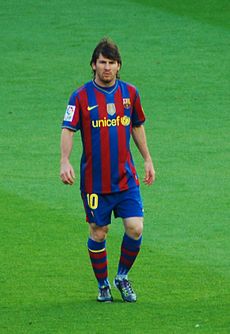
Lionel Messi was born, 24 June 1987, in Rosario, Argentina to a working-class family. His father was a factory steel worker, and his mother a cleaner.
He began playing from an early age, and his talent was soon apparent. However, at the age of 11, Messi was diagnosed with growth hormone deficiency (GHD). This was a condition that stunted growth and required expensive medical treatment, including the use of the drug Human growth hormone.
His local club, River Plate were interested in signing Messi but didn’t want to pay for his medical treatment. However, Messi was given a trial with Barcelona, and coach Carles Rexach was impressed – offering Messi a contract (written on a paper napkin!) which included paying for Messi’s treatment in Spain. Messi moved to Barcelona with his father and became part of the prestigious FC Barcelona youth academy.
“I made a lot of sacrifices by leaving Argentina, leaving my family to start a new life. But everything I did, I did for football, to achieve my dream. That’s why I didn’t go out partying, or do a lot of other things.”
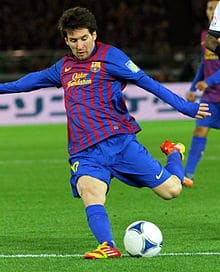
Messi progressed through the ranks and was given his first appearance in the 2004/05 season becoming the youngest player to score a league goal. In 2006, Messi was part of the double winning team which won both La Liga (Spanish League) and Champions League. By next season, (2006-07) aged just 20, Messi was the first choice striker and an essential part of the Barcelona team – scoring 14 goals in 26 league games.
In the 2009-10 season, Messi scored 47 goals in all competitions, equalling Ronaldo’s record total for Barcelona. As the seasons have progressed, Messi kept improving and breaking his own records. In the calendar year of 2012, he broke the all-time world record for most goals scored in a calendar year. His final total of goals in 2012 was 91 – beating the previous record of 85 by German Gerd Muller, and Pele’s milestone of 75 in 1958.
“My record stood for 40 years – 85 goals in a year – and now the best player in the world has broken it, and I’m delighted for him. He is an incredible player, gigantic.”
At the start of 2013, in club football, Messi has scored 292 goals from a total of 359 appearances, and in international football, 31 goals from 76 appearances.
At the end of 2012, Messi turned down a very lucrative offer to play for an unnamed Russian side. It would have given Messi a salary of €20 million a year and made Messi the most expensive player in the world (Barcelona would have been paid €250 million). He turned down the offer because he was unsure if he would be playing in major European championships and the difficulties in moving to Russia. Instead, he signed a contract with Barcelona until the end of 2018. When asked about moving to the English Premier League, Messi revealed his sense of commitment to Barcelona.
“ Barcelona is my life. They have brought me to where I am today. I could not leave, I don’t want to leave. I know the Premier League is very good. But I cannot see myself playing in England because my heart is with Barcelona, always.”
International Career
Because Messi was brought up in Spain, since he was 11 years old, he has Spanish nationality. In 2004, he was offered the chance to play for Spain’s Under 20 side, but Messi decided to play for Argentina, the country of his birth. He led Argentina to victory in the 2005 FIFA Youth Championship. Messi made his full international debut in August 2005, during a friendly against Hungary. In his first game, Messi was sent off for allegedly elbowing a player. The decision was contentious and not in keeping with Messi’s style of play which is generally clean and in the spirit of fair play; he has very rarely been accused of diving.
In 2006, he participated in the World Cup, becoming Argentina’s youngest player to play in the world cup. Argentina were eliminated in the quarter-finals. In 2008, he won an Olympic gold medal for Argentina in football at the Beijing Olympics. Initially, Barcelona had not allowed him permission to play, but new coach Pep Guardiola allowed him time off.
In the 2010 World Cup, Messi wore the number 10 shirt and played well to help Argentina reach the quarter-finals, but Messi struggled to score, and Argentina disappointingly lost 4-0 to Germany in the quarter-final. Messi has admitted he is desperate to play in a world cup final. Success for Messi in the World Cup would be the last test of greatness. Pele, by contrast, was part of Brazil’s three times winning World Cup side ’58, ’62 and ’70.
Messi is widely regarded as one of the most exciting players of the modern age – in fact, any age. He has a peerless ability to dribble and take on opponents. Maradona has described his ball control as supremely good. “The ball stays glued to his foot; I’ve seen great players in my career, but I’ve never seen anyone with Messi’s ball control.” Messi has said he wishes to retain the joy of how a child plays football
“I have changed nothing, my style of play is still that of a child. I know that above all it is my job and that I should approach it in another way, but one must not lose sight of the fact that football is a game. It is imperative one plays to amuse oneself, to be happy. That is what children do and I do the same thing.” (total Barca)
After winning the Ballon d’Or for the fourth time in January 2013, Messi said:
“To tell you the truth this is really quite unbelievable. The fourth award that I have had is just too great for words. ” (BBC)
Messi and Ronaldo
Messi has often been compared to prolific Real Madrid goalscorer Christiano Ronaldo, but both have been keen to downplay the rivalry.
“Messi has his personality and I have mine. He has his game and I have mine. I also play in a big club like him. We are different in every aspect. But right now, he is the best.”
Messi’s goalscoring record

Source: Christopher Johnson, Barcelona FC. CC-SA-2.5
By any standards, Messi’s goal scoring record is exceptional. By June 2019, he has scored 419 goals in 445 official matches for Barcelona FC.
Messi major honours
Barcelona
Argentina
Wealth and income
Private life
By the standards of modern football, Messi has a relatively private and modest lifestyle. He makes efforts to keep links to his hometown of Rosario. He has an Argentinian girlfriend Antonella Roccuzzo, and they have two children. His first child Thiago was born in November 2012.
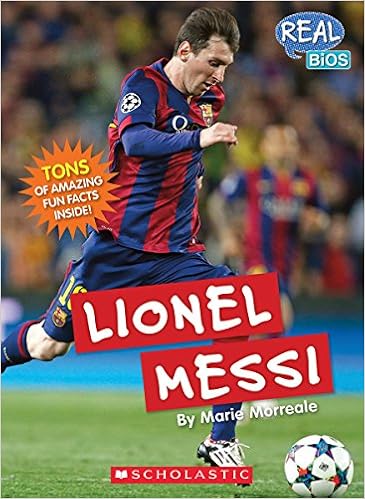 Recommended Book – Lionel Messi – Real Bios
Lionel Messi – Real Bios at Amazon by Marie Morreale.
Messi acts as an ambassador for Unicef, and also runs his own charitable foundation – supporting access to education and sport for children. Because of his own expensive medical treatment, he has also helped Argentinian hospitals with paying for similar treatment to his own.
World Cup 2014
Many commentators have stated that Lionel Messi has performed at his best in all competitions, except the World Cup. In both the 2006 and 2010 World Cup, Argentina were knocked out in the quarter-finals, with Messi not at his best.
The 2014 World Cup in Brazil is an opportunity for Messi to make an impact on the highest stage of them all. In the opening game against, Bosnia – Herzegovina, Messi scored a great goal to give Argentina a winning start. He scored four goals to help Argentina reach the World Cup Final. In the final, Argentina lost 1-0 to Germany. Messi was awarded ‘Golden Ball’ player of the tournament, though the decision was not universally supported. After the tournament, Messi replied:
“I do not care about the Golden Ball. I am just upset by the wasted chances. We had the best chances. We knew we could not dominate the game but we knew what we wanted to do. Right now I do not care about my prize. I just wanted to lift the cup and bring it to Argentina. The pain is very great.”
In June 2016, a very disappointed Messi announced his retirement from international football, after missing a penalty as Argentina got knocked out of the Copa America final. However, Messi later reversed his decision, saying he loved playing for Argentina too much, and “I see there are many problems in Argentinian football and I don’t intend to create another one.”
However, Messi returned to international football and led Argentina in the 2018 World Cup. Despite carrying the weight of expectation of a nation, the World Cup was considered a great dissappointment. However, in the 2018/19 season Messi returned to his usual scintillating performance with Barcelona.
Published 10 January 2018. Last updated 10 December 2019.
Stats
Lionel Messi

Lionel Messi (Leo Messi) Biography
Lionel Andrés Messi Cuccittini, known as Lionel Messi or simply “Lio”, is an Argentinian footballer who was born in Rosario, Argentina, on June 24, 1987, and plays as a forward or right winger. He comes from a family with fewer economic resources, made up of his father, Jorge Horacio Messi, a factory worker and his mother, Celia María Cuccittini. His maternal grandmother, Celia Olivera, was the one who motivated him to play football as a professional. For that reason, in 1992, when he was 5 years old he began his training as a soccer player in the club.
Abanderado Grandoli, which was one of Rosario’s formative teams. In 1994, Lionel Messi took his step through the lower divisions of Newell’s Old Boys where he began to show his skill with the ball and won several national titles. At the age of 11, Lionel would be diagnosed with a deficiency in growth hormone, which made him look less attractive for the soccer clubs despite the great talent he had. However, this was not an impediment for Messi to continue with his aspirations to be a professional footballer.
FC BARCELONA
His aspirations to achieve his goals took him to Buenos Aires in August of 2000 to try out in the Club Atlético River Plate’s Academy, requested by coach Federico Vairo who saw his great talent. Nevertheless, Messi was never called back to the club because River Plate did not reach an economic agreement with his parents to treat his growth problem. On September, Messi and his father would travel to Barcelona, Spain to look out for a better future and try out in some soccer clubs, including FC Barcelona. The day after his arrival in Barcelona, he was scheduled to attend a practice with one of the FC Barcelona’s Youth Academy teams. However, this practice was canceled because of the absence of Rexach who was in charge of the team’s youth academy.
Weeks later, Lionel Messi had the opportunity to make his first practices with the category Infantile A of FC Barcelona. This was a successful start in which he could score
6 goals and take the lead in his team. Messi’s performance was so good that he was asked to play for the other team in the second half.
On December 14, 2000, Horacio Gaggioli (Manager of Messi at that time) and Carles Rexach signed Messi for the FC Barcelona Youth Academy. In his beginnings in the Masía, Messi teamed with Gerard Piqué and Cesc Fábregas and was directed by Tito Vilanova. His debut in an official game with Infantile B category was on March 7, 2001, against Amposta. That game was a dreamed debut because Messi would score the winning goal for the victory of his team. In the next game, Lionel will fracture his fibula after a player from the other team kicked him and Messi missed the rest of that season.
At the end of 2001, at the beginning of a new season, Lionel Messi was promoted to the Infantile A category, where he was famous for scoring 21 goals in 14 games. The excellent performance showed by “Lio” allowed him to be promoted in 2002 to the Cadet A category, with which he would win all the tournaments that the team played. In the 2003-2004 season, he had a small step through the Juvenil B category where his skills with the ball got him a spot in the Barcelona C team, where he debuted on November 29, 2003, in the third division tournament of Spain.
Messi’s footballing growth was accelerating, so he did not last long in the youth categories. His move to Barcelona B took place on March 6, 2004, and sometimes was called by the professional team to practice with them or play some exhibition games.
Lionel Messi was still part of the Barcelona B when he debuted with the professional team on November 16, 2003, in a friendly game against Porto from Portugal. In the 2004-2005 season, Lionel did the preseason with the professional team, where he participated in 3 games played at the Camp Nou and scored a goal.
His debut in an official game occurred on October 16, 2004, when he was 17 years old. Barcelona’s coach, Frank Rijkaard was the one who gave him the opportunity against Espanyol, a game for the Spanish league.
His first official goal with Barcelona came on May 1, 2005, in the game corresponding to the 34th fixture against Albacete. That season, Barcelona would become champion again after five seasons without any titles. The 2005-2006 season started full of successes for the player since the team managed to be champion of the super cup of Spain on August 13, 2005. In that year, the Catalan Club renewed Messi’s contract until 2014 and improved his salary as a reward for the excellent performance that the player had shown in the main squad. Due to this, Lionel saw great possibilities in the club, so on September 26 of that year, he received the Spanish nationality.

In the middle of November, the first “Clasico” came for Lionel Messi against Real Madrid, the match was won by Barcelona 3-0 and the player gave an assist. Next month, he would win the Golden Boy Award, leaving Cristiano Ronaldo and Wayne Rooney in with the second and third position respectively. Through the 2005-2006 season, Messi suffered an injury that kept him away from the team until his total recovery. At that time, Messi had scored 7 goals in 18 games including league and Champions League. At the end of the season, Lio had won two more titles with the Barcelona FC as the team won the Spanish league and the Champions League.
In the 2006-2007 season, the Argentinian star was already a key player in Barcelona’s starting lineup. On March 10, 2007, Messi played another game against Real Madrid in which he scored his first hat-trick in a game that would end up 3-3 and became the youngest player to score in “El Clasico”. Due to all the records, Messi was achieving and the way he played, made the people start comparing him with Diego Armando Maradona.
One of the most famous goals of the player and for which they compared him more with Maradona, was the one he scored on April 18, 2007, in which he escaped from 6 players and defined very coldly. That goal was practically identical to the one Maradona scored in the 1986 World Cup against England. The player finished that season with 14 goals scored in 38 matches.
The 2007-2008 season, Messi scored 16 goals and was included in FIFA’s ideal team and ranked third in the Golden Ball Award. Despite these recognitions, that season, the player did not get any title with the club. On February 27, 2008, he would play his 100th game with the Blaugrana shirt against Valencia.
The season 2008-2009 would start with the Argentinian star wearing the number 10 and becoming a symbol for Barcelona. This season was full of important titles and goals. He became an important icon in the history of the club, after scoring the goal number 5000 in the league for Barcelona on February 1, 2009. In addition, the two goals scored in the historic Barcelona win against Real Madrid were highlighted by 6- 2 at the Santiago Bernabéu on May 2 of that same year. On May 27, 2009, Barcelona played the final of the Champions League against Manchester United, a match in which Messi scored the second goal in the 2-0 that meant the European title for his club. At the end of the season, the player scored 38 goals in 51 games, including Copa del Rey, the Champions League, and the Spanish League, and became the champion of the three mentioned competitions.
The 2009 season came with excellent news for Lionel Messi since on September 18, 2009, Barcelona decided to renew the player’s contract until 2016 ensuring the player for a good time because whoever wanted him had to pay 250 million euros. By that time the player was already recognized by several journalists and coaches around the world, as the best player in the world never seen before. To the talent, the goals and abilities of the player began to add the great recognition and references; this made that on December 1 of that same year Lionel won his first FIFA Golden Ball (currently called Golden Ball and delivered by the magazine France Football) after obtaining 480 points and being the first player that came out from the Barcelona youth academy in obtaining this award.
At the age of 22, Messi would become the youngest player to score 100 goals with the Blaugrana shirt and the first player in scoring two consecutive hat-tricks. Messi continued to break records, and on April 6, 2010, he scored his first goal-scoring poker game in the quarter-final match of the Champions League, where Barcelona won 4-1. The player became the club’s all-time leading scorer in that competition, after reaching 25 goals. At the end of the season, Lionel added a few more titles with Barcelona as he won the Spanish league, the Spanish Super Cup, the European Super Cup and the Club World Cup; he managed to score 34 goals in the league, 1 goal in Copa del Rey, 2 in the Spanish Super Cup and 8 in the Champions League and was named the best player of the year on June 3, 2010.
Lionel Messi became the third leading scorer in the history of Barcelona FC after reaching 131 goals on August 29, 2010, which was an excellent start to the season for the player. Between October 20 to November 24, Messi managed to score in 10 consecutive games, a personal record achieved by the Argentinian. In December, Messi would be nominated for the fourth time to the Golden Ball Award, this time contesting against teammates Xavi Hernandez and Andres Iniesta. Messi would end up winning this award for the second time in a row, which identified him as the best player in the world. After the end of the 2010-2011 season, the player scored 12 goals in the Champions League, 31 in the league, 7 in Copa del Rey and 3 in the Spanish Super Cup. In addition, he was champion of the Spanish league and the Champions League adding the title number 15 in his football career.
On August 25, 2011, Messi won the award for the best player in Europe in its first edition, beating Xavi Hernández and Cristiano Ronaldo. The 2011-2012 season started with Messi winning the aforementioned prize, also he was chosen as the sports heritage of humanity in Argentina. He played the Spanish Super Cup against Real Madrid, where he scored 3 goals that contributed to Barcelona winning its tenth Super Cup and the player became the top scorer of that competition with 8 goals, beating the historic Raúl Gonzales.
On August 26, 2011, Barcelona played the European Super Cup against Porto, in which Messi scored a goal that contributed to the 2-0 victory and to get the fourth title of this competition for Barcelona FC. On December 8, 2011, the player was recognized as the second-best player in the history of the UEFA Champions League surpassed only by the historic Zinedine Zidane. A few days later, Messi would play his 293rd match with the Barcelona jersey and became the foreign player with most matches played in the Spanish club. On December 18, 2011, Lionel Messi and Barcelona were crowned champions of the Club World Cup, after defeating Santos (Brazil) 4-0 where he contributed 2 goals to the score, also received the Golden Ball as the best player of the competition.
At the beginning of 2012, Lionel would be given his third consecutive Golden Ball equaling the record of Michel Platini. Messi culminated the 2011-2012 season with a total of 67 goals in all competitions and managed to win the Spanish Super Cup, the European Super Cup, and the FIFA Club World Cup. On October 27, 2012, Lionel Messi scored two goals in the 5-0 against Rayo Vallecano, which reached a historical figure of 300 goals as a professional and was making history. On January 7, 2013, the player would win the Golden Ball for the fourth time in a row and was part of FIFA’s 11th ideal for the sixth consecutive year. For the 6 of 2013, Messi signed the renewal of his contract, which linked him until 2018 with the Blaugrana team. In the match against Granada of the current season, Lionel Messi scored two goals reaching the global figure of 301 goals in 365 games with Barcelona FC. In addition, he became the first player in the world to score in 17 consecutive fixtures in a professional football league.
On March 30, 2013, the Argentinian crack took the captain’s band for the first time in an official match with Barcelona. On May 11, 2013, Barcelona won the Spanish league with four games in advance and Messi added his twentieth title with Barcelona. He also managed to be the league’s top scorer and got for the third time the top scorer and the league’s golden boot. At the end of the 2012-2013 season, the Argentinian player ended up scoring 46 goals in the Spanish league, 4 in Copa del Rey, 2 in the Spanish Supercup and 8 in the Champions League.
On August 28, 2013, at the start of the 2013-2014 season, Barcelona managed to win the Super Cup of Spain and Messi added his title number 23 with the Blaugrana shirt. On January 22, 2014, reached 400 games with Barcelona FC in the 4-1 victory against Valencia for the knockout stages of the Copa del Rey, the Argentine stood out for giving 3 assists to Cristian Tello. In that season, the Argentinian continued breaking records and in this case reached the figure of 337 goals reaching the third place in the Spanish league’s top scorers along with Raul, surpassing what Alfredo Di Stéfano did. The Argentine managed to finish that season with 41 goals.
In the 2014-2015 season, Lionel Messi reached 71 goals in the Champions League and managed to equal Raul as the top scorer of that competition. On November 22, 2014, he became the top scorer of the Spanish league reaching the figure of 253 goals, after scoring 3 goals in the 5-1 victory against Sevilla. Three days later, he would score a hat-trick in her team’s 4-0 victory against Apoel for Champions League. That hat-trick helped him to reach 74 goals in that competition and became the leading top scorer. On April 18, 2015, the Argentinian reached 400 goals with Barcelona and became the player with the most goals scored for the same Spanish team. On May 17, 2015, Barcelona defeated Atlético de Madrid 1-0 with a Messi goal that allowed them to reach  the Spanish league championship. Messi was also the protagonist 3 days later (May 30, 2015) when he scored two goals in the Copa del Rey final against Athletic Bilbao, that match was won by Barcelona 3-1 and gave Barcelona the title. On June 6, 2015, the “10” would achieve another treble to Barcelona, after becoming champion of the European champions league, beating Juventus of Italy. At the end of that season, Lionel Messi scored 43 goals for the Spanish league, 5 goals for Copa del Rey and 10 goals for the Champions League. On August 28, 2015, the Argentine star managed to win the best player-in-Europe award for the second time.
The 2015-2016 season did not start very well for Messi and Barcelona, as they lost the final of the Spanish Super Cup against Sevilla. Days later, on September 16, Lio would become the youngest player to play 100 games in the Champions League, in the draw against Roma 1-1. On December 17, 2015, the participation of Barcelona in the club world championship began, defeating the Guangzhou Evergrande by 3-0 in semifinals and winning the title after beating River Plate of Argentina 3-0, with a goal of Messi. The beginning of 2016 was very good for Lionel Messi, since on January 11 he won again the Golden Ball as the best player in the world, adding 5 Golden Balls in his soccer career, the player was also part of the ideal team of the FIFA in that year. The course of the league was good for his team, and on March 13, 2016, Lionel managed to equal the world record of assists of Juan Román Riquelme at the club and national level, with 247 goal passes. In that season, the Argentine star achieved 4 titles (Club World Cup, Spanish League, Copa del Rey and European Super Cup) and scored 41 goals.
On August 17, 2016, Lionel Messi managed to win his first championship as captain of Barcelona, winning the Super Cup of Spain to Sevilla by a global score of 6-1. On May 27, 2017, Barcelona was champion of the Copa del Rey 2016-2017, after defeating Deportivo Alaves 3-1 in the final with a Goal and assistance from the Argentinian. On July 5 of the same year, Messi renewed his contract with Barcelona until 2021. On August 7, he was chosen by CIHEFE as the best player in the history of the Spanish league. On October 23, 2017, Messi was part of FIFA / FIFPro World XI chosen by FIFA, which refers to the ideal eleven of the season. On November 24, 2017, Lionel Messi received the Golden Boot for having been the scorer of the European competitions of the 2016-2017 season, where he managed to score 37 goals.
ARGENTINA NATIONAL TEAM
Lio Messi has been part of the Argentina National Team for a long time. In 2014, he played his first game with the U-20 team, in a friendly against Paraguay in which he scored a goal and gave two assists. In July, he would play another game against Uruguay’s U-20 team in which he contributed with two goals for the 4-1 victory of his team. This was enough for him to be taken into account in the squad that faced the South America tournament U-20 in 2005.
The South America tournament was held in Colombia, and Messi scored 6 goals and finally managed to qualify for the Under 20 World Championship to be held in the Netherlands after finishing in the third position of the final hexagonal. In the World Youth Championship in June 2005, Argentina won the final against Nigeria, and the Argentinian crack managed to provide 6 goals to his team and was the top scorer of the competition, lifting the Golden Boot and the Golden Ball to the best player of the tournament.
In 2008, Messi played the Olympic Games held in Beijing. Argentina debuted on August 7 with a 2-1 victory against the Ivory Coast, scoring the first goal of the game. In the second match of the group stage, Argentina won 1-0 to Australia, securing their qualification to the next round. However, in the last match of this phase, Argentina won 3-0 to Serbia, consolidating as leader of their group. In the final rounds, Argentina built its way to the final for the Olympic gold beating the Netherlands and Brazil by 2-1 and 3-0 respectively, where Lio contributed a goal. The Olympic title was won after beating Nigeria 1-0 in the final. This was the second title with National Youth Teams for the player.
After good performances in youth teams, Lionel Messi began to be called to the senior team, where he made his debut on August 17, 2005, in a friendly match against Hungary. In that game, he was sent off after a fight with a defender of the opposing team. His debut in an official match took place on September 3, 2005, when Argentina faced Paraguay for the World Cup qualifiers to Germany 2006.
Messi’s first goal with the senior team was scored in a friendly against Croatia on March 1. 2006. In World Cup in Germany 2006, Lionel Messi was among the list of players called by coach José Pekerman, becoming the youngest Argentinian player to contest the world cup. He debuted on the first game against Serbia in the 6-0 win in favor of Argentina. In this game, Messi would enter the minute 73 and managed to score a goal. In the last group game against the Netherlands, Messi was in the starting lineup. However, in the final stages, he only played 30 minutes until his team was eliminated before Germany.
After the participation in the 2006 World Cup, Messi would keep being called to the national team and on June 5, 2007, he scored his first double with the national team in a friendly match against Algeria prior to the Copa America 2007. His participation in the Copa America 2007 was highlighted, as he scored two goals in the quarterfinals and semifinal, but despite his good performance, his team would not reach the title, because it was defeated in the final by Brazil with a score of 3-0.
Messi continued being called up for the games with his national team, among them those that were competing for the classification of the World Cup in South Africa 2010. In the qualifiers, Messi would end up score 4 goals. By May 19, 2010, Lionel Messi would be called by Diego Maradona, to dispute the World Cup that year. Messi had a good performance in the World Cup, despite not scoring any goal and being eliminated in the quarterfinals against the German national team.
In 2011, he played the Copa America hosted in Argentina, and the pressure Messi had was gigantic since Argentina was the host and the fans demanded that the player show the level he had at Barcelona. Argentina managed to pass the group stage on a regular basis with 5 points. However, in the quarterfinals, Uruguay finished with Argentina’s dream. The qualifiers for the World Cup in Brazil 2014 were fruitful for the player as he scored 10 goals and gave 5 assists that contributed to Argentina finishing first in the South American classification and achieving a place at the World Cup.
In the 2014 World Cup, the name of Messi was indisputable on the squad list. In his debut on June 15, the player scored 1 goal in Argentina’s 2-0 victory against Bosnia-Herzegovina. In the second match, Messi would score the goal with which Argentina beat the Iranian national team on June 21. In the last match of the group stage played on June 25 against Nigeria, the player scored two  goals in the victory of his team 3-2, qualifying the next round as first of the group. In the round of 16, Argentina beat Switzerland 1-0, and Lionel gave assistance for that goal. The quarter-final phase would be victorious for Messi and his team, as they beat Belgium 1-0 on July 5. The passage to the final of the competition took place, after beating the Dutch national team in penalties by a score of 4-2, where the player scored the first penalty kick. On July 13 Argentina played the final against Germany, where there was a draw in the first 90 minutes. However, Germany won the world title after scoring a goal at minute 114.
After the failure of Messi and his team, Messi would be awarded the Golden Ball that identified him as the best player in the world, a prize that did not overshadow the sadness of the player for having lost the final. On May 25, 2015, Lionel Messi topped the list of 23 summoned to face the Copa America in Chile. In that competition, Messi reached 100 matches played with Argentina, scored a goal, gave 3 assists and reached the final of the tournament being runner-up, after falling 4-2 in definition from the penalty spot against Chile.
On June 18 of 2016, while playing the 100th version of the Copa America, the player equaled Batistuta as top scorer of the Argentina team with 54 goals. Nevertheless, on June 21st in the semifinal match of that competition, Messi scored a goal that allowed him to beat the Batistuta record. The Argentina team played the final against Chile, where another misfortune for Lio Messi came, as Argentina lost the final again. Despite having contributed a lot and having scored 5 goals, the frustration of the player was such that at the end of the game he decided to retire from the national team, highlighting that he had tried a lot to achieve a title and this had been impossible. Fortunately, thanks to talks with friends and Argentina’s coach, on August 12, Messi would announce that he would return to the national team to play all his competitions.
Lionel Messi played the qualifiers for the 2018 World Cup with the Argentine national team, where he remained the maximum symbol for the team and scored 7 goals. In addition, on October 10, 2017, he scored the 3 goals with which Argentina defeated Ecuador 3-1 as a visitor and achieved the qualification for the World Cup in Russia.
MESSI OFF THE FIELD
Apart of his football characteristics, Lionel Messi has been recognized for the willingness to help people who need it, so in 2007 he created the Leo Messi Foundation, whose role is to help children and adolescents with educational and health problems.
Through this foundation, parks, sports centers, and social areas have been built. The player also collaborates in charity events independently by participating in exhibition matches and conducting campaigns to raise funds. This type of social work made Unicef named him the ambassador of good will. From 2008 up to date, the player has a relationship with Antonella Roccuzzo, with whom he has two children: Thiago and Mateo.
In 2013, Messi’s financial movements were investigated and it was found that there were illegal movements to evade taxes related to sponsorship and advertising profits in the period between 2007 and 2009. The player and his father were found guilty of tax fraud and sentenced to 21 months in prison with a fine of more than 3 million euros. However, after reaching an agreement he was granted only the payment of the fine and not pay the sentence in prison.